
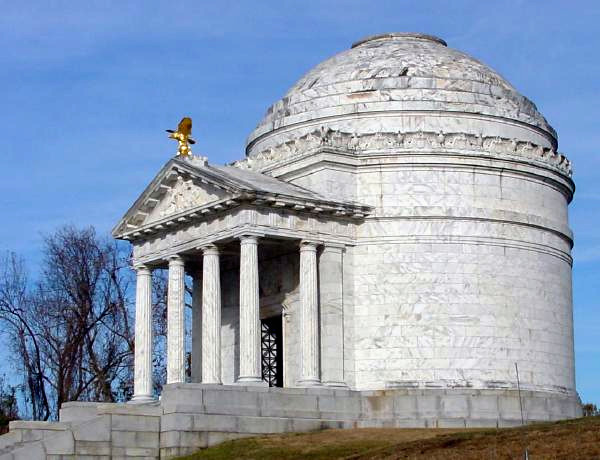
By Joseph Novak – Flickr, CC BY 2.0, https://commons.wikimedia.org/w/index.php?curid=37834696
3201 Clay St, Vicksburg, MS 39183-3495
Overview
Vicksburg National Military Park preserves the site of the American Civil War Battle of Vicksburg, waged from March 29 to July 4, 1863. The park, located in Vicksburg, Mississippi, flanking the Mississippi River, also commemorates the greater Vicksburg Campaign which led up to the battle. Reconstructed forts and trenches evoke memories of the 47-day siege that ended in the surrender of the city. Victory here and at Port Hudson, farther south in Louisiana, gave the Union control of the Mississippi River.
The park includes 1,325 historic monuments and markers, 20 miles (32 km) of historic trenches and earthworks, a 16-mile (26 km) tour road, a 12.5-mile (20.1 km) walking trail, two antebellum homes, 144 emplaced cannons, the restored gunboat USS Cairo (sunk on December 12, 1862, on the Yazoo River), and the Grant’s Canal site, where the Union Army attempted to build a canal to let their ships bypass Confederate artillery fire.
The Cairo, also known as the “Hardluck Ironclad,” was the first U.S. ship in history to be sunk by a torpedo/mine. It was recovered from the Yazoo in 1964.
The remnants of Grant’s Canal, a detached section of the military park, are located across from Vicksburg near Delta, Louisiana. With the approval of President Abraham Lincoln, the project was commenced by Union Army Major General Benjamin Butler in June 1862, with the work assigned to Brigadier General Thomas Williams. The project was halted in July of that year due to massive amount of disease and sickness among the soldiers and former slaves doing the hard labor of constructing the ditch, and falling water levels on the river.
in January 1863, Union Army Major General Ulysses S. Grant ordered the project re-started as part of his Vicksburg Campaign; the task was assigned to Brigadier General William T. Sherman. Neither Grant nor Sherman had any faith in the success of the canal, but the scheme was a favorite of Lincoln’s.
The goal of the project was to alter the course of the Mississippi River in order to bypass the Confederate guns at Vicksburg. For various technical reasons the project failed to meet this goal. Grant, however, utilized the canal project to keep his troops occupied during the laborious maneuvering required to begin the Battle of Vicksburg.
Our Partners

About An American Journey Forty-8
AnAmericanJourneyForty-8 provides contestants with real world experiences to create some amazing memories. Millions of people make New Years resolutions every year to travel, only to fall short and quit. Our Goal is to inspire millions to travel and create lifelong memories.
Signup to be Notified
We are preparing the program and will contact you when it goes live.