
By HAL333 – Own work, CC BY-SA 4.0, https://commons.wikimedia.org/w/index.php?curid=91641938
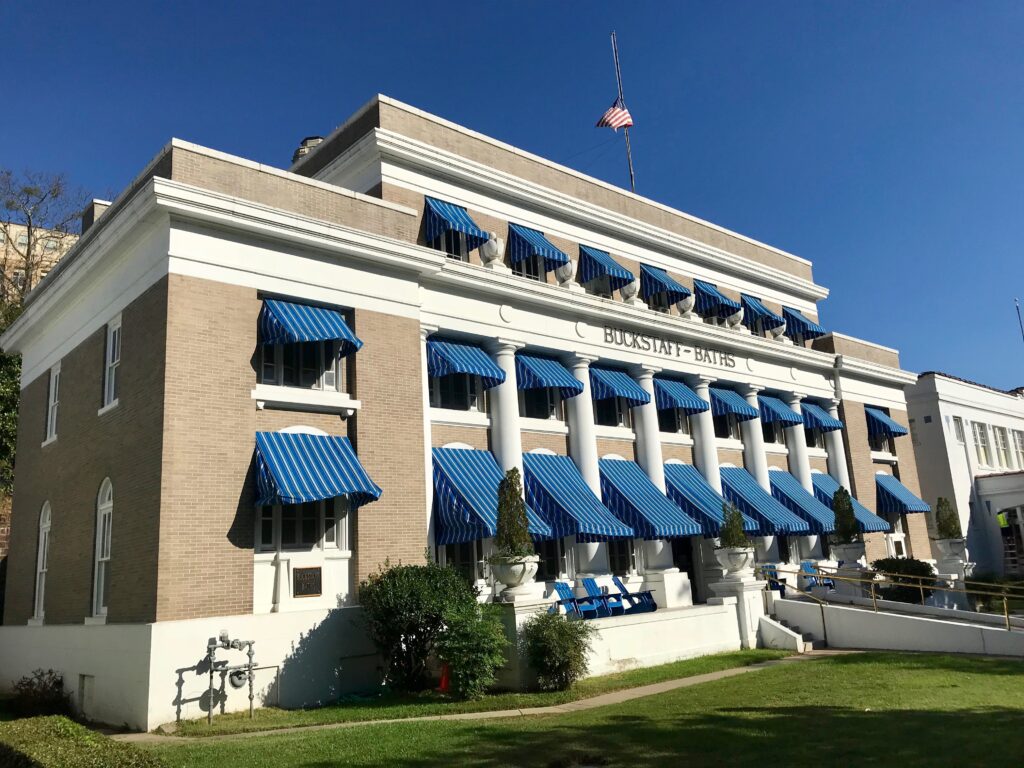
Buckstaff Bathhouse
509 Central Avenue, Hot Springs, Arkansas 71901
Overview
Bathhouse Row is a collection of bathhouses, associated buildings, and gardens located at Hot Springs National Park in the city of Hot Springs, Arkansas. The bathhouses were included in 1832 when the Federal Government took over four parcels of land to preserve 47 natural hot springs, their mineral waters which lack the sulphur odor of most hot springs, and their area of origin on the lower slopes of Hot Springs Mountain.
The existing bathhouses are the third and fourth generations of bathhouses along Hot Springs Creek, and some were built directly over the hot springs. Because of this resource, the area was set aside in 1832 as the first federal reserve. The bathhouses are a collection of turn-of-the-century eclectic buildings in neoclassical, renaissance-revival, Spanish and Italianate styles aligned in a linear pattern with formal entrances, outdoor fountains, promenades, and other landscape-architectural features.
Bathhouse Row was designated a National Historic Landmark on May 28, 1987. The Bathhouse Row contains eight bathhouses aligned in a row: Buckstaff, Fordyce, Hale, Lamar, Maurice, Ozark, Quapaw, and Superior. These were independent, competing, commercial enterprises. The area included in the National Historic Landmark also includes a Grand Promenade on the hill above the bathhouses, an entrance way including fountains, and a National Park Service Administration building.
Buckstaff – Completed in 1912, the elegantly designed Buckstaff Baths operates under National Park Service regulations, its well-trained staff provides a range of services from tradition thermal mineral baths and body massages to Swedish style full body massages. The bathing tubs are private and bathing suits are optional, although visitors may cover themselves between the bathing stations. Services begin with a “Whirlpool Mineral Bath” for a fee.
The Fordyce bathhouse is the most elaborate and was the most expensive of the bathhouses, the cost including fixtures and furniture being $212,749.55 US. It was closed on June 29, 1962, the first of the Row establishments to fall victim to the decline in popularity of therapeutic bathing. Fordyce Bathhouse has served as the park visitor center since 1989. In style, the building is primarily a Renaissance Revival structure, with both Spanish and Italian elements. The building is a three-story structure of brick construction, with a decorative cream-colored brick facing with terra cotta detailing. A marquee of stained glass and copper with a parapet of Greek design motifs overhangs the open entrance porch. The north and south end walls have curvilinear parapets of Spanish extraction. These side walls have highly decorative terra cotta windows on the first floor.
By HAL333 – Own work, CC BY-SA 4.0, https://commons.wikimedia.org/w/index.php?curid=91641938
Crater of Diamonds State Park, AR
209 State Park Rd Murfreesboro, AR 71958
Overview
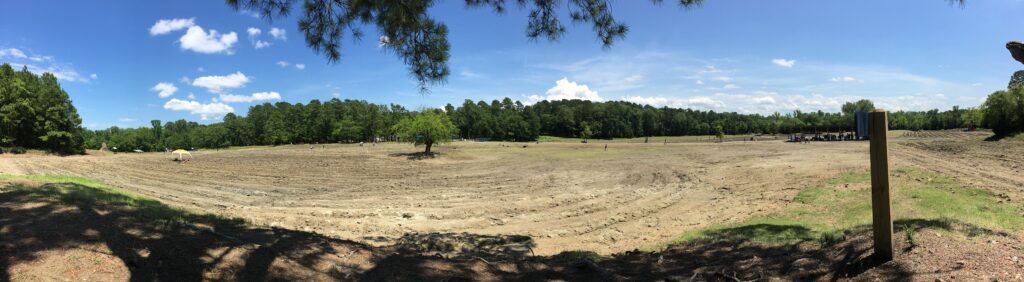
Crater of Diamonds State Park is a 911-acre (369 ha) Arkansas state park in Pike County, Arkansas, in the United States. The park features a 37.5-acre (15.2-hectare) plowed field, one of the few diamond-bearing sites accessible to the public. Diamonds have been discovered in the field continuously since 1906, including the graded-perfect Strawn-Wagner Diamond, found in 1990, and the Uncle Sam, found in 1924, which at over 40 carats is the largest diamond ever found in the United States.
The site became a state park in 1972 after the Arkansas Department of Parks and Tourism purchased the site from private owners in Dallas, Texas, who had previously operated the site as a tourist attraction.
In August 1906, John Huddleston found two strange crystals on the surface of his 243-acre farm near Murfreesboro, Arkansas. The following month, Huddleston and his wife, Sarah, sold an option on the property to a group of Little Rock investors headed by banker-attorney Samuel F. (Sam) Reyburn, who undertook a careful test of the property. From the sub-surface diamond matrix, Reyburn’s team extracted about two carats per hundred short tons of material (the standard tram-cart loads, each carrying about 1,600 pounds of material). Federal testing in 1943-1944 and State sponsored testing in the 1990s produced virtually the same result.
After 1906, several attempts at commercial diamond mining failed. The only significant yields came from the original surface layer on the east half of the Crater — a black and sticky gumbo clay ranging from about one to four feet thick. Natural erosion, rocks, and vegetation had concentrated diamonds there over a long period of time.
Because equipment of the early period usually included bottom screens with mesh larger than 1/16th inch, thousands of smaller diamonds were allowed to pass through during testing. The bulk of these ended up in shallow drainage cuts all over the diamond field and in the big natural drains on its east and west edges. Since the State of Arkansas acquired the Crater, in 1972, regular plowing on the east side has marked the main field, 30 to 35 acres of easily eroded breccia. In recent decades, the old east and west drains have been especially fruitful for recreational diamond diggers.
Notable diamonds from the bottom of the east drain include the flawless white Strawn-Wagner diamond, weighing 3.03 carats in the rough. Shirley Strawn of Murfreesboro, Arkansas, came up with this celebrated gem in 1990.
Our Partners

About An American Journey Forty-8
AnAmericanJourneyForty-8 provides contestants with real world experiences to create some amazing memories. Millions of people make New Years resolutions every year to travel, only to fall short and quit. Our Goal is to inspire millions to travel and create lifelong memories.
Signup to be Notified
We are preparing the program and will contact you when it goes live.