
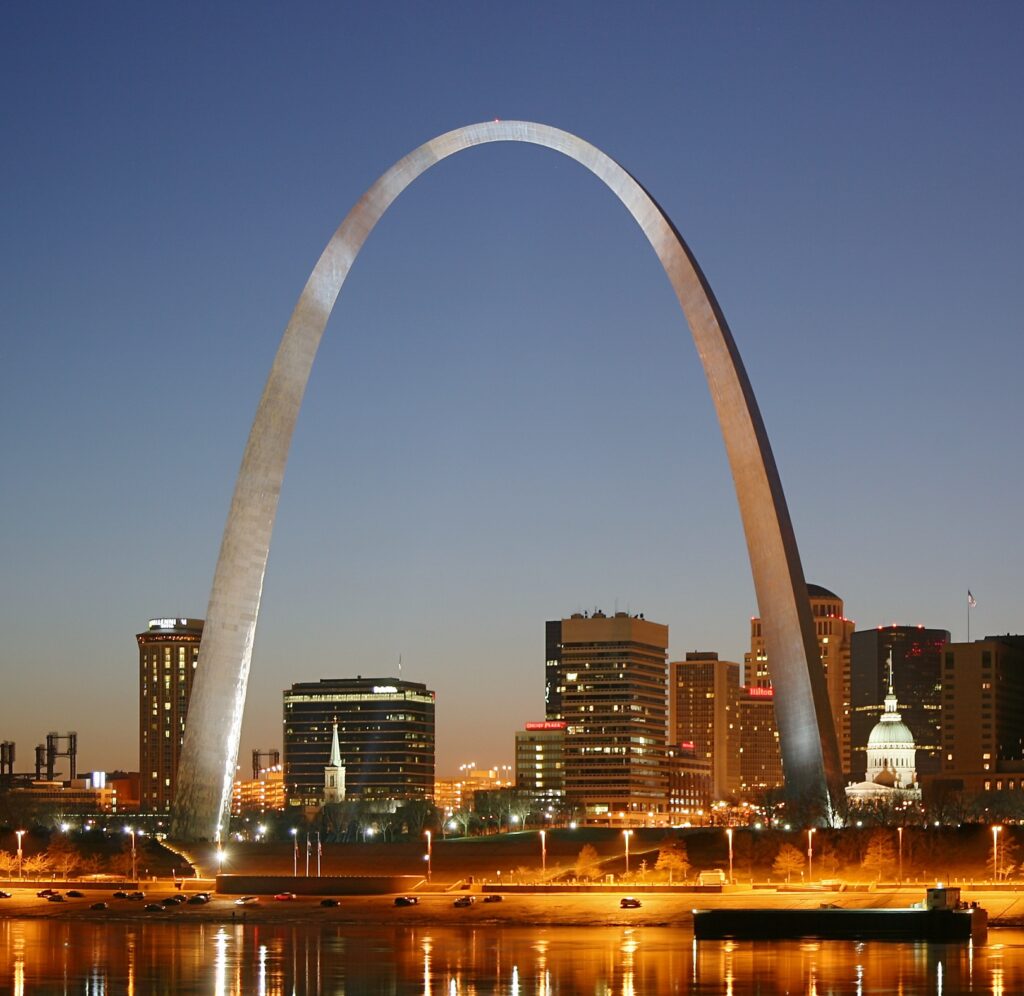
Gateway Arch
100 Washington Avenue St. Louis, Missouri, 63102
Overview
The Gateway Arch is a 630-foot-tall (192 m) monument in St. Louis, Missouri, United States. Clad in stainless steel and built in the form of a weighted catenary arch, it is the world’s tallest arch and Missouri’s tallest accessible structure. Some sources consider it the tallest human-made monument in the Western Hemisphere. Built as a monument to the westward expansion of the United States and officially dedicated to “the American people”, the Arch, commonly referred to as “The Gateway to the West”, is a National Historic Landmark in Gateway Arch National Park and has become a popular tourist destination, as well as an internationally recognized symbol of St. Louis.
The Arch was designed by the Finnish-American architect Eero Saarinen in 1947, and construction began on February 12, 1963 and was completed on October 28, 1965, at an overall cost of $13 million (equivalent to $95.9 million in 2023). The monument opened to the public on June 10, 1967. It is located at the 1764 site of the founding of St. Louis on the west bank of the Mississippi River.
The project did not provide 5,000 jobs as expected—as of June 1964, workers numbered fewer than 100. The project did, however, incentivize other riverfront restoration efforts, totaling $150 million. Building projects included a 50,000-seat sports stadium, a 30-story hotel, several office towers, four parking garages, and an apartment complex. The idea of a Disneyland amusement park that included “synthetic riverboat attractions” was considered but later abandoned. The developers hoped to use the arch as a commercial catalyst, attracting visitors who would use their services. One estimate found that since the 1960s, the arch has incited almost $503 million worth of construction.
In June 1976, the memorial was finalized by federal allocations—”the statue of Thomas Jefferson was unveiled, the Museum of Westward Expansion was previewed, a theater under the Arch was dedicated in honor of Mayor Raymond Tucker and the catenary-like curving staircases from the Arch down to the levee were built.”
The structural load is supported by a stressed-skin design. Each leg is embedded in 25,980 short tons (23,570 t) of concrete 44 feet (13 m) thick and 60 feet (18 m) deep. Twenty feet (6.1 m) of the foundation is in bedrock. The arch is resistant to earthquakes and is designed to sway up to 18 inches (46 cm) in either direction, while withstanding winds up to 150 miles per hour (240 km/h). The structure weighs 42,878 short tons (38,898 t), of which concrete composes 25,980 short tons (23,570 t); structural steel interior, 2,157 short tons (1,957 t); and the 6.3mm thick grade 304 stainless steel panels that cover the exterior of the arch, 886 short tons (804 t). This amount of stainless steel is the most used in any one project in history.
Our Partners

About An American Journey Forty-8
AnAmericanJourneyForty-8 provides contestants with real world experiences to create some amazing memories. Millions of people make New Years resolutions every year to travel, only to fall short and quit. Our Goal is to inspire millions to travel and create lifelong memories.
Signup to be Notified
We are preparing the program and will contact you when it goes live.