
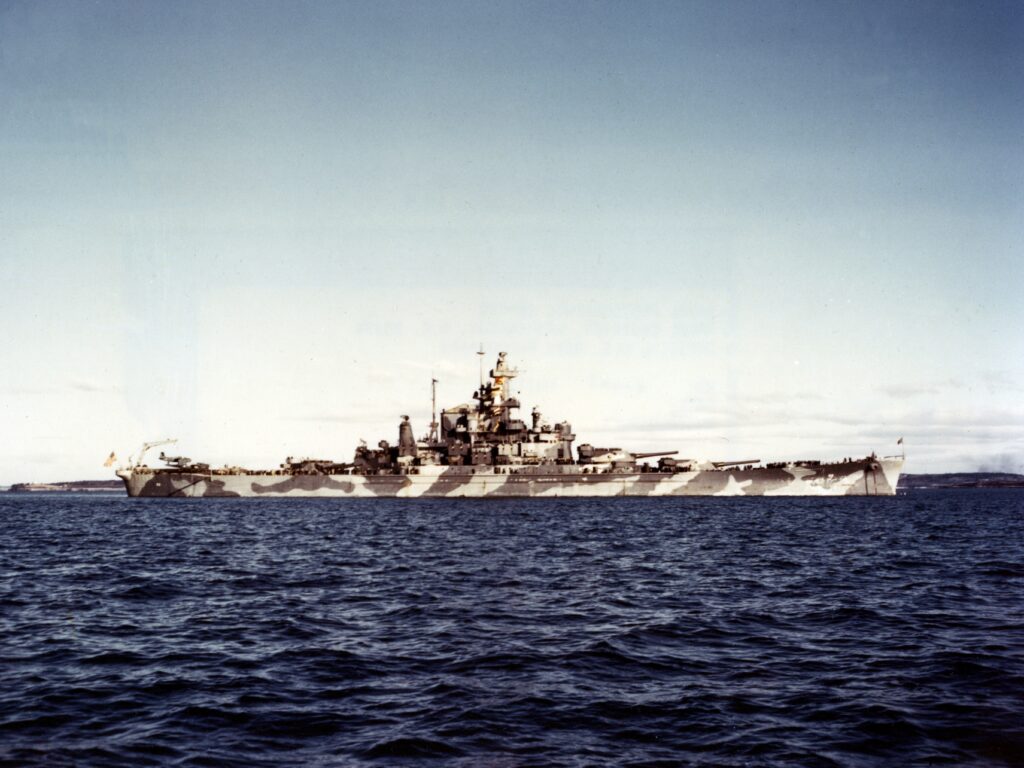
USS Alabama, AL
8:00 AM – 5:00 PM | INFORMATION: 251-433-2703
2703 Battleship Pkwy, Mobile, AL 36602-8003
Renaissance Mobile Riverview Plaza Hotel 1 (844) 631-0595
64 South Water Street, Mobile, AL 36602-8003
Overview
USS Alabama (BB-60) is a retired battleship. She was the fourth and final member of the South Dakota class of fast battleships built for the United States Navy in the 1940s. The first American battleships designed after the Washington Treaty system began to break down in the mid-1930s, they took advantage of an escalator clause that allowed increasing the main battery to 16-inch (406 mm) guns, but Congressional refusal to authorize larger battleships kept their displacement close to the Washington limit of 35,000 long tons (36,000 t). A requirement to be armored against the same caliber of guns as they carried, combined with the displacement restriction, resulted in cramped ships. Overcrowding was exacerbated by wartime modifications that considerably strengthened their anti-aircraft batteries and significantly increased their crews.
After entering service, Alabama was briefly deployed to strengthen the British Home Fleet, tasked with protecting convoys to the Soviet Union. In 1943, she was transferred to the Pacific for operations against Japan; the first of these was the Gilbert and Marshall Islands campaign that began in November that year. While operating in the Pacific, she served primarily as an escort for the fast carrier task force to protect the aircraft carriers from surface and air attacks. She also frequently bombarded Japanese positions in support of amphibious assaults. She took part in the Mariana and Palau Islands campaign in June–September and the Philippines campaign in October–December. After a refit in early 1945, she returned to the fleet for operations during the Battle of Okinawa and the series of attacks on the Japanese mainland in July and August, including several bombardments of coastal industrial targets. Alabama assisted in Operation Magic Carpet after the war, carrying some 700 men home from the former war zone. She was decommissioned in 1947 and assigned to the Pacific Reserve Fleet, where she remained until 1962 when she was stricken from the Naval Vessel Register. A campaign to save the ship from the breakers’ yard succeeded in raising the necessary funds, and Alabama was preserved as a museum ship in Mobile Bay, Alabama.
The South Dakota class was ordered in the context of global naval rearmament during the breakdown of the Washington treaty system that had controlled battleships construction during the 1920s and early 1930s. Under the Washington and London treaties, so-called treaty battleships were limited to a standard displacement of 35,000 long tons (36,000 t) and a main battery of 14-inch (356 mm) guns. In 1936, following Japan’s decision to abandon the treaty system, the United States Navy decided to invoke the “escalator clause” in the Second London treaty that allowed displacements to rise to 45,000 long tons (46,000 t) and armament to increase to 16 in (406 mm) guns.
Our Partners

About An American Journey Forty-8
AnAmericanJourneyForty-8 provides contestants with real world experiences to create some amazing memories. Millions of people make New Years resolutions every year to travel, only to fall short and quit. Our Goal is to inspire millions to travel and create lifelong memories.
Signup to be Notified
We are preparing the program and will contact you when it goes live.