
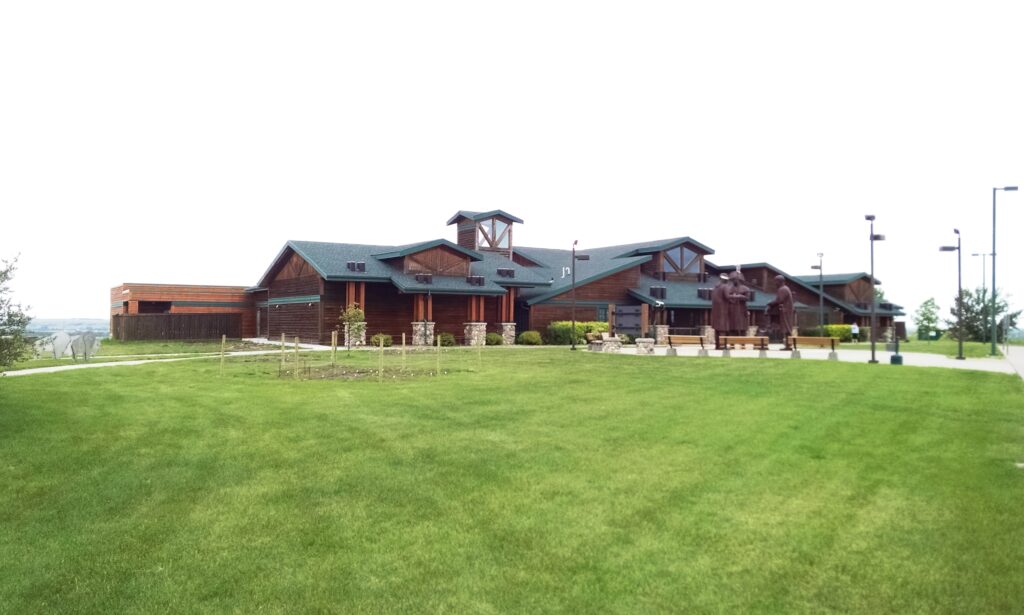
Lewis and Clark Center
2576 8th St SW, Washburn, ND 58577-9579
Overview
The North Dakota Lewis and Clark Interpretive Center, operated by the North Dakota Parks and Recreation Department, interprets the history of the Lewis and Clark Expedition. It focuses on the winter of 1804–1805, which they spent at Fort Mandan, a post they built near a Mandan village. The center was opened in 1997 and overlooks the Missouri River on the outskirts of Washburn, North Dakota (38 miles north of Bismarck, North Dakota’s capital), the center opened in 1997. It is located about two miles from the reconstructed Fort Mandan. The Lewis and Clark Expedition, also known as the Corps of Discovery Expedition, was the United States expedition to cross the newly acquired western portion of the country after the Louisiana Purchase. The Corps of Discovery was a select group of U.S. Army and civilian volunteers under the command of Captain Meriwether Lewis and his close friend Second Lieutenant William Clark. Clark, along with 30 others, set out from Camp Dubois (Camp Wood), Illinois, on May 14, 1804, met Lewis and ten other members of the group in St. Charles, Missouri, then went up the Missouri River. The expedition crossed the Continental Divide of the Americas near the Lemhi Pass, eventually coming to the Columbia River, and the Pacific Ocean in 1805. The return voyage began on March 23, 1806, at Fort Clatsop, Oregon, ending six months later on September 23 of that year. President Thomas Jefferson commissioned the expedition, shortly after the Louisiana Purchase of 1803, to explore and detail as much of the new territory as possible. Furthermore, he wished to find a practical travel route across the western half of the continent—directly avoiding the hot and desolate desert southwest—and to establish an American presence in the new lands before European powers attempted to establish claims of their own. The campaign’s secondary objectives were scientific, economical and humanitarian, i.e., to document the West’s biodiversity, topography and geography and to establish positive trade relations with (potentially unknown) Native American tribes. The expedition returned to St. Louis to report their findings to President Jefferson via maps, sketches, and various journals. In 1803, Jefferson commissioned the Corps of Discovery and named Army Captain Meriwether Lewis its leader, who then invited William Clark to co-lead the expedition with him. Lewis demonstrated remarkable skills and potential as a frontiersman, and Jefferson made efforts to prepare him for the long journey ahead as the expedition was gaining approval and funding. Jefferson explained his choice of Lewis: It was impossible to find a character who to a complete science in botany, natural history, mineralogy & astronomy, joined the firmness of constitution & character, prudence, habits adapted to the woods & a familiarity with the Indian manners and character, requisite for this undertaking. All the latter qualifications Capt. Lewis has. In 1803, Jefferson sent Lewis to Philadelphia to study medicinal cures under Benjamin Rush, a physician and former leader in the American Revolution. He also arranged for Lewis to be further educated by Andrew Ellicott, an astronomer who instructed him in the use of a sextant, among other navigational instruments.
Our Partners

About An American Journey Forty-8
AnAmericanJourneyForty-8 provides contestants with real world experiences to create some amazing memories. Millions of people make New Years resolutions every year to travel, only to fall short and quit. Our Goal is to inspire millions to travel and create lifelong memories.
Signup to be Notified
We are preparing the program and will contact you when it goes live.