
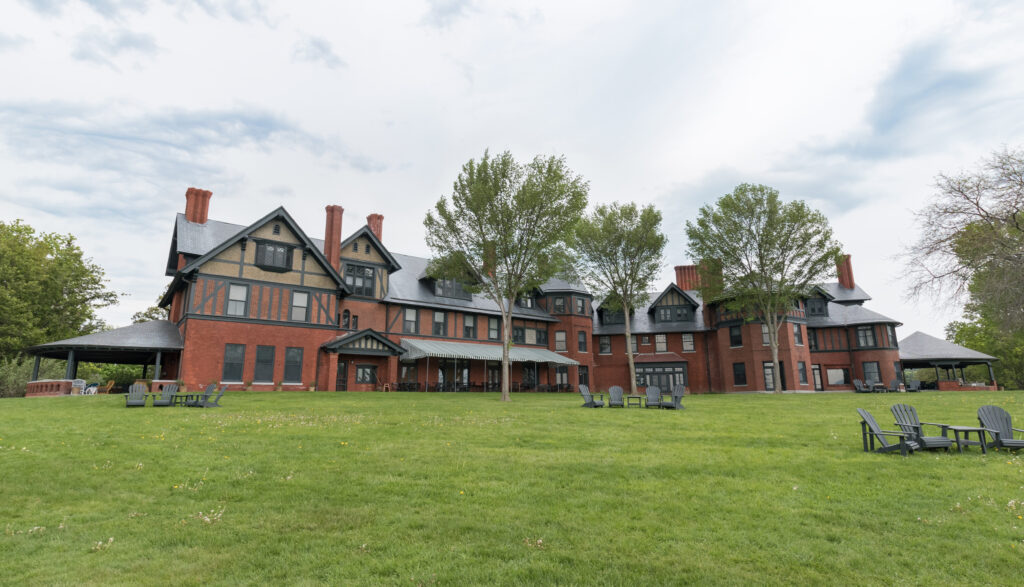
By Joseph Novak – Flickr, CC BY 2.0, https://commons.wikimedia.org/w/index.php?curid=37834696
Inn at Shelburne Farms
1611 Harbor Road, Shelburne, VT 05482
Website
https://shelburnefarms.org
Overview
As descendants of the earliest PaleoIndians, the Abenaki are the first people of this land they call N’dakinna, or “Our Land.” For much of the 17th century, they hunted, fished, and gathered food in the region. Like their ancestors, the Abenaki relied on the lakes and streams for transport and game, living in evental villages alongside these waterways.. By the time the Town of Shelburne was chartered in 1773, Europeans were already bringing enormous change to the area. They pushed out, destroyed, suppressed, or assimilated many Abenaki people, though communities survived on existing shoreline settlements. By 1790, the town recorded nearly 400 residents. By mid-century, Shelburne had over 1,000 residents and over 17,000 sheep on the land. But as railroads and settlers moved west, cheap western wool compelled many Shelburne farmers to diversify into dairy farming and orchards—or to head west themselves. The railroads driving this shift made the Vanderbilt family fortune, which would soon underwrite the creation of Shelburne Farms. Eliza Osgood “Lila” Webb was the youngest daughter of William H. Vanderbilt, one of the world’s wealthiest men when he died in 1885. Her inheritance enabled her and her husband, William Seward, to realize their personal vision for a grand agricultural estate in Shelburne. Over more than a decade, they purchased 33 farms—nearly 4,000 acres—along Shelburne Point. Families of original settlers—Tracy, Hart, Saxton, and Comstock to name a few—sold their farms to the Webbs, whether seeking prosperity or feeling pressured. The enduring name of Shelburne Farms plural reflects this history of consolidation. Underwritten by Lila’s fortune, another landscape transformation began. Hundreds of laborers removed most of the original farm buildings, eliminated boundary walls, plowed under existing roads that linked to town, constructed new ones, and planted acres of trees, such as elms, maples, and pines. Even the terrain was reshaped: an 1892 ledger records costs for “removing Hurlbert Hill.” The Saxton family’s land became a house site; greenhouses were built on the former Hart Farm. Agriculture was a throughline between the earlier farms and new estate, though on vastly different scales with vastly disparate resources. The Webbs invested in innovative equipment, tools, labor, and technologies to enhance production and efficiency across a staggering range of operations: horse-breeding, a dairy, sheep flock, a piggery, chickens, hay and grain crops for feed, and extensive gardens and greenhouses. As the 20th century progressed, the estate’s complex, labor-intensive operations became increasingly unsupportable and were scaled back, especially after Lila Webb’s death in 1936. The nonprofit’s tenure with the land has been marked by a deep commitment to sustainable agriculture, healthy local food systems, and above all, to education. Shelburne Farms has built a thriving farm–dairy, cheesemaking, sugarmaking, and organic gardens.
Our Partners

About An American Journey Forty-8
AnAmericanJourneyForty-8 provides contestants with real world experiences to create some amazing memories. Millions of people make New Years resolutions every year to travel, only to fall short and quit. Our Goal is to inspire millions to travel and create lifelong memories.
Signup to be Notified
We are preparing the program and will contact you when it goes live.