
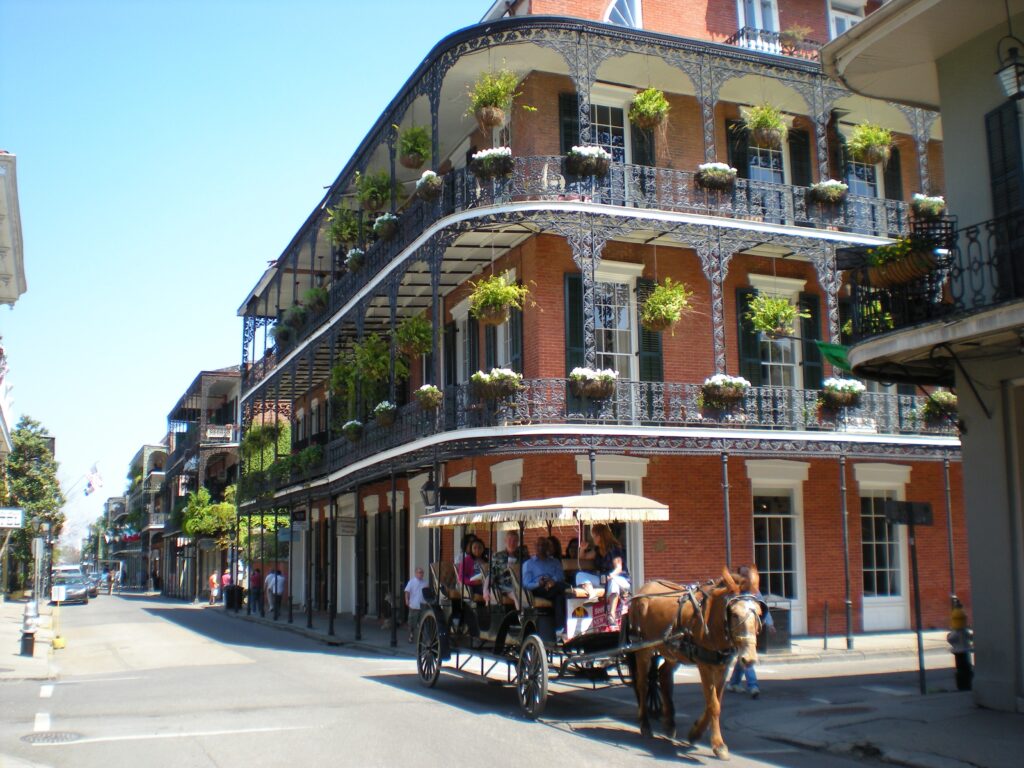
By Joseph Novak – Flickr, CC BY 2.0, https://commons.wikimedia.org/w/index.php?curid=37834696
French Quarter, LA
Courtyard by Marriott New Orleans Downtown
124 St. Charles Avenue, New Orleans, LA 70130
Overview
The French Quarter, also known as the Vieux Carré French: [vjø kaʁe]), is the oldest neighborhood in the city of New Orleans. After New Orleans (French: Nouvelle-Orléans) was founded in 1718 by Jean-Baptiste Le Moyne de Bienville, the city developed around the Vieux Carré (“Old Square” in English), a central square. The district is more commonly called the French Quarter today, or simply “The Quarter”, related to changes in the city with American immigration after the 1803 Louisiana Purchase. Most of the extant historic buildings were constructed either in the late 18th century, during the city’s period of Spanish rule, or were built during the first half of the 19th century, after U.S. purchase and statehood. The district as a whole has been designated as a National Historic Landmark.
The French claimed Louisiana in the 1690s and Jean Baptiste Le Moyne de Bienville was appointed Director General in charge of developing a colony in the territory, and founded New Orleans in 1718. In 1721, the royal engineer Adrien de Pauger designed the city’s street layout. He named the streets after French royal houses and Catholic saints, and paid homage to France’s ruling family, the House of Bourbon, with the naming of Bourbon Street.[page needed] New Orleans was ceded to the Spanish in 1763 following the Seven Years’ War. The Great New Orleans Fire of 1788 and another in 1794 destroyed 80 percent of the city’s buildings, and so nearly all the French Quarter dates from the late 1790s onwards.
The Spanish introduced strict new fire codes that banned wooden siding in favor of fire-resistant brick, which was covered in stucco, painted in the pastel hues fashionable at the time. The old French peaked roofs were replaced with flat tiled ones, but the still largely French population continued to build in similar styles, influenced by colonial architecture of the Caribbean, such as timber balconies and galleries. (In southeast Louisiana, a distinction is made between “balconies”, which are self-supporting and attached to the side of the building, and “galleries,” which are supported from the ground by poles or columns.)
When Anglophone Americans began to move in after the Louisiana Purchase in 1803, they mostly built on available land upriver, across modern-day Canal Street. This thoroughfare became the meeting place of two cultures, one Francophone Creole and the other Anglophone American. (Local landowners had retained architect and surveyor Barthelemy Lafon to subdivide their property to create an American suburb). The median of the wide boulevard became a place where the two contentious cultures could meet and do business in both French and English. As such, it became known as the “neutral ground”, and this name is still used for medians in the New Orleans area
Our Partners

About An American Journey Forty-8
AnAmericanJourneyForty-8 provides contestants with real world experiences to create some amazing memories. Millions of people make New Years resolutions every year to travel, only to fall short and quit. Our Goal is to inspire millions to travel and create lifelong memories.
Signup to be Notified
We are preparing the program and will contact you when it goes live.